You're doing everything you can. But you can't do it all.
As a pediatrician, therapist, or school provider, you care deeply about your families — but feeding concerns? They're messy, complex, and time-consuming.
You've probably been there:
- A child eats five foods… but they're still growing
- A parent insists something is wrong… but you don't see a clear medical diagnosis
- You want to help… but you're out of time, tools, or referrals
That's where a trusted feeding therapy referral makes all the difference. You want to support them. But you also don't have 45 minutes to explain sensory feeding aversions, oral motor delays, or ARFID.
That's where Foodology Feeding steps in — and it looks a little different depending on where you're sitting. Jump to the checklist and scripts built for your role below.
Who do I see for this?
Feeding concerns don't always fall neatly into one specialty. This is the chart our own team uses when a symptom could point to a few different directions.

Spot the red flags at well visits. Refer without needing a diagnosis first.
Feeding issues are often dismissed as "just picky eating." Left unaddressed, they can spiral into nutritional deficiencies, anxiety, ARFID, or Pediatric Feeding Disorder. You don't need a formal diagnosis to refer — a pattern of concern is enough.
✓Ask about at the well visit
- Eats fewer than 20 total foods
- Eliminates entire food groups or textures
- Refuses previously accepted foods and doesn't regain them
- Gags, vomits, or cries in response to food exposure
- Insists foods be prepared exactly the same way every time
- Shows extreme rigidity, anxiety, or panic at meals
- Ongoing constipation, reflux, or suspected food sensitivities
- Stuck at a feeding milestone (e.g., never progressed from purées)
- Avoids eating in front of others or at school
- Infants: latch/bottle difficulty, poor weight gain, suspected tongue or lip tie, feeding fatigue, rough transition to solids
≡Do's & don'ts
Do
- Ask "Tell me about mealtimes at home" — open-ended, not yes/no
- Refer based on pattern of concern, even without a clean diagnosis
- Run bloodwork: CBC, iron, zinc and copper
- Refer to an allergist to rule out black and white food allergies
- Track growth trend over time, not just today's percentile
- Validate the parent's gut feeling, even if labs look normal
Don't
- Say "they'll grow out of it" without asking about the pattern
- Rule out concern just because growth curve looks fine
- Wait for weight loss before referring
- Tell parents to "just keep offering" with no concrete plan
When nutrition education isn't translating to intake, the barrier usually isn't nutritional.
You can build the "perfect" meal plan and still watch a child refuse it. That's usually a sign the barrier is sensory, oral-motor, or nervous-system based — not a knowledge gap.
✓Red flags to watch for
- Nutrient or variety goals stall despite a solid nutrition plan
- Parent reports mealtime battles even when the plan looks "textbook"
- Client is resistant to any exposure-based or behavioral coaching
- Suspected sensory component behind refusal (texture, smell, temperature)
- GI symptoms — constipation, reflux, bloating — alongside restriction
- History of NG-tube or G-tube weaning
- Growth concerns paired with strong food aversions, not just low intake
- Formula or supplement dependence beyond the expected age
≡Do's & don'ts
Do
- Loop in feeding therapy when education alone isn't moving intake
- Coordinate on gut-brain factors — constipation and refusal are linked
- Share labs and growth data with the feeding team (with consent)
- Name the sensory/motor piece out loud to parents, not just the numbers
Don't
- Push volume or calorie goals before sensory/motor barriers are addressed
- Assume refusal is non-compliance
- Recommend "one more bite" or finish-your-plate rules
PFD can look exactly like ARFID or happen alongside ARFID— and you shouldn't have to tease them apart.
Pediatric Feeding Disorder often presents with the same anxiety, rigidity, and mealtime distress you'd expect from ARFID. But PFD has an oral-motor or sensory skill deficit underneath it — something that can only be accurately identified through oral-motor and sensory testing.
✓Red flags to screen for that might indicate this is not all psychological
- Feeding anxiety has prgressed over years. There is usually a past history of feeding challenges early on since birth
- Food avoidance is specific to textures or food groups. Look for patterns like avoiding harder to chew foods like meats and vegetables.
- Child may have senosry sensitivites that extend beyond just food
- There was not an identifiable traumatic event surrounding the food
- Ask if the child has any of the following: extended chewing times, frequently spitting out food, chewing on one side of the mouth, or messy eating --these can be signs of oral motor or skill based defecits
- Kids can go long periods of time without asking for food, rarely notice or complain of being hungry, or graze all day slowly.
- Parents report bloating , excessive gassiness, distended belly, constipation, excessive vomiting, and frequent illness-- these can be signs the issue is more medically based.
≡Do's & don'ts
Do
- Treat rigidity + food refusal as a reason to rule out a skill deficit, not just an anxiety diagnosis
- Refer to a myofunctional therapist or an SLP with specific advanced oral-motor training who can accurately assess for a skill deficit
- Coordinate co-treatment so exposure work and oral-motor work happen at the same time
Don't
- Diagnose or rule out PFD yourself — it requires oral-motor, gut, and sensory testing
- Refer to a generalized speech pathologist — you need someone with specific advanced oral-motor training, not general SLP scope
- Treat food avoidance as purely behavioral or willpower-based
- Assume that past feeding therapy has ruled out oral motor and gut issues. It is rare for parents to have received the full story and often have been dismissed by other professionals or have used a general therapist who wasn't trained to differntially diagnose these issue.
When a plateau in general therapy is actually a feeding-specific barrier.
Feeding draws on oral-motor, sensory, and postural systems all at once. If progress in general OT or PT isn't carrying over to the table, it's often worth a feeding-specific evaluation rather than more of the same intervention.
✓Red flags to watch for
- History of tongue ties, open mouth breathing, snoring, and dental crowding
- Sensory presentation extends beyond what a general sensory diet addresses
- Gagging or choking at meals beyond what's typical for age
- Articulation errors — especially R, L, or TH — that persist well beyond the typical developmental timeframe
- Postural or positioning issues visibly affecting intake
- Child has plateaued in general sensory/motor work with no change at the table
- Suspected tongue tie or structural airway concern
≡Do's & don'ts
Do
- Refer when progress plateaus specifically around eating, even if general therapy is going well
- Refer persistent R/L/TH errors to someone with advanced oral-motor training and myofunctional therapy if general artic therapy isn't moving the needle
- Collaborate on carryover between clinics — shared strategies stick better
- Share the sensory profile and motor findings you already have
Don't
- Treat articulation in isolation from the whole-body sensory/motor/feeding picture
- Assume picky eating is outside your scope to flag, even if it's outside your scope to treat
Refer in parallel with the workup — not after everything's been ruled out.
Families often land in feeding therapy only after months of medical workups come back clear. Referring alongside the workup, rather than after it, gets families support faster and keeps behavioral patterns from setting in.
✓Red flags to watch for
- Reflux or constipation workup is clear, but refusal persists
- Post-tube-weaning transition needing feeding support
- Parents report sensitivity to certain food despite allergist ruling out any food allergies
- Growth faltering with no clear medical etiology
- Child is eliminating a pattern of certain textures or food groups
≡Do's & don'ts
Do
- Refer alongside the medical workup, not after it's "ruled everything out"
- Refer to allergist to rule out black and white food allergies
- Flag behavioral patterns early, before they become entrenched
Don't
- Wait for a clean diagnosis before considering feeding therapy
- Treat persistent refusal as purely a GI symptom once labs are normal
You often see the mealtime struggle before anyone else does.
What happens at the lunch table is some of the most useful information a family can get. You don't need to diagnose anything — just describe what you see and let the parent take it from there.
✓What to notice at mealtime
- Child eats significantly less or differently at school than parents describe at home
- Refuses to eat in front of peers, hides food, or shows distress at lunchtime
- Rigid food rules — won't eat if foods touch, needs specific packaging or brands
- Gags or vomits during meals in the classroom setting
- Consistently sent home with an untouched lunch
- Peers comment on or react to how the child eats
≡Do's & don'ts
Do
- Share specific observations with parents — what, how much, how the child reacted
- Let the child bring safe foods without comment or shame
- Allow opportunities to practice exploring new foods when possible
Don't
- Enforce a "no thank you bite" rule
- Comment on how much a child ate in front of peers
- Use dessert, stickers, or rewards tied to eating
What you see in the mouth often is affecting speech or feeding.
Tongue thrust, narrow palates, and prolonged oral habits don't exist in isolation — they're frequently tied to the same oral-motor patterns driving a child's food refusal or speech impediment. You're often the first provider to spot the physical signs, well before a parent connects them to mealtime struggles.
✓Red flags to watch for
- Tongue thrust or low resting tongue posture affecting bite development
- High, narrow, or vaulted palate
- Persistent mouth breathing or low tongue resting posture
- Open bite, crossbite, or malocclusion
- Strong gag reflex that interferes with exams
- Prolonged pacifier, bottle, or thumb habit well past the expected age
- Cavities concentrated in a child eating a very limited, carb-heavy, or highly processed diet
- Child shows anxiety or resistance at the dentist that mirrors mealtime refusal patterns
≡Do's & don'ts
Do
- Ask about feeding and speech history when you see tongue thrust, narrow palate, or persistent oral habits
- Coordinate myofunctional therapy to work with any potential orthdontic work
- Flag when limited diet — not just hygiene — looks like it's driving decay
Don't
- Treat tongue thrust or open bite as purely mechanical/orthodontic without asking about feeding or speech
- Recommend a tongue-tie release without coordinating myofunctional therapy before and after
- Assume a parent's mention of picky eating is unrelated to what you're seeing in the exam
A structured pathway designed to uncover the root cause of feeding struggles.
One pathway, no matter who sends the family our way.
Comprehensive Evaluation
We evaluate oral-motor function, sensory processing, nutritional patterns, medical history, and mealtime dynamics — with food sensitivity and gut microbiome testing when clinically appropriate.
Targeted Implementation
Families move directly into 8 implementation sessions, turning findings into guided, practical progress through parent coaching and clear next steps.
Ongoing Support When Needed
For complex cases, twice-monthly support sessions continue — with the child included on calls when direct oral-motor work is needed.
Help Families Access Insurance Coverage
We provide physicians with a simple documentation template that can help support medical necessity when families pursue out-of-network reimbursement or a gap exception for feeding therapy.
Download Medical Necessity Template- ✔ Includes feeding disorder diagnosis codes
- ✔ Includes gap exception request wording
- ✔ Designed for pediatric feeding therapy referrals
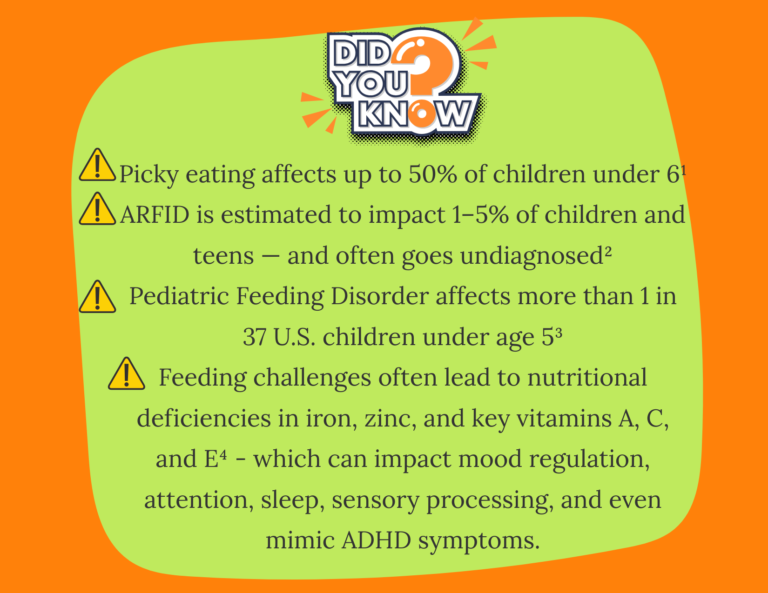
- ⚠️ Picky eating affects up to 50% of children under 61
- ⚠️ ARFID is estimated to impact 1–5% of children and teens — and often goes undiagnosed2
- ⚠️ Pediatric Feeding Disorder affects more than 1 in 37 U.S. children under age 53
- ⚠️ Feeding challenges often lead to nutritional deficiencies in iron, zinc, and key vitamins A, C, and B4,5,6
We make you the hero.
We're a specialized feeding therapy team that helps families get real answers and tangible progress — while making you look like the provider who connected the dots. When you refer to Foodology, here's what you can expect:
- ✅ A thorough evaluation and action plan parents have been begging for
- 🕒 Progress updates (with consent) — no extra admin for you
- 💬 No pressure to "diagnose" outside your scope
- 🙌 Confidence that tricky cases are being handled seriously and holistically
And the best part? You won't see that same family cycling through your office again and again with no plan.

The 4 Pillars of Feeding Success™
We don't just manage symptoms — we get to the root. Every evaluation and intervention runs through all four pillars.
Oral-Motor Function
Chewing patterns, bolus formation, postural stability, and oral coordination — including structural issues like tongue tie that often go undetected.
Sensory Processing
Over- and under-responsivity across the sensory systems that drive refusal, anxiety, or avoidance — matched to the child's regulation profile.
Gut & Nutritional Health
Constipation, food intolerances, and nutrient gaps that affect appetite and regulation — addressed alongside functional providers.
Feeding Mindset & Regulation
Co-regulation, play-based exposure, and nervous-system-informed strategies that rebuild safety, trust, and curiosity around food.
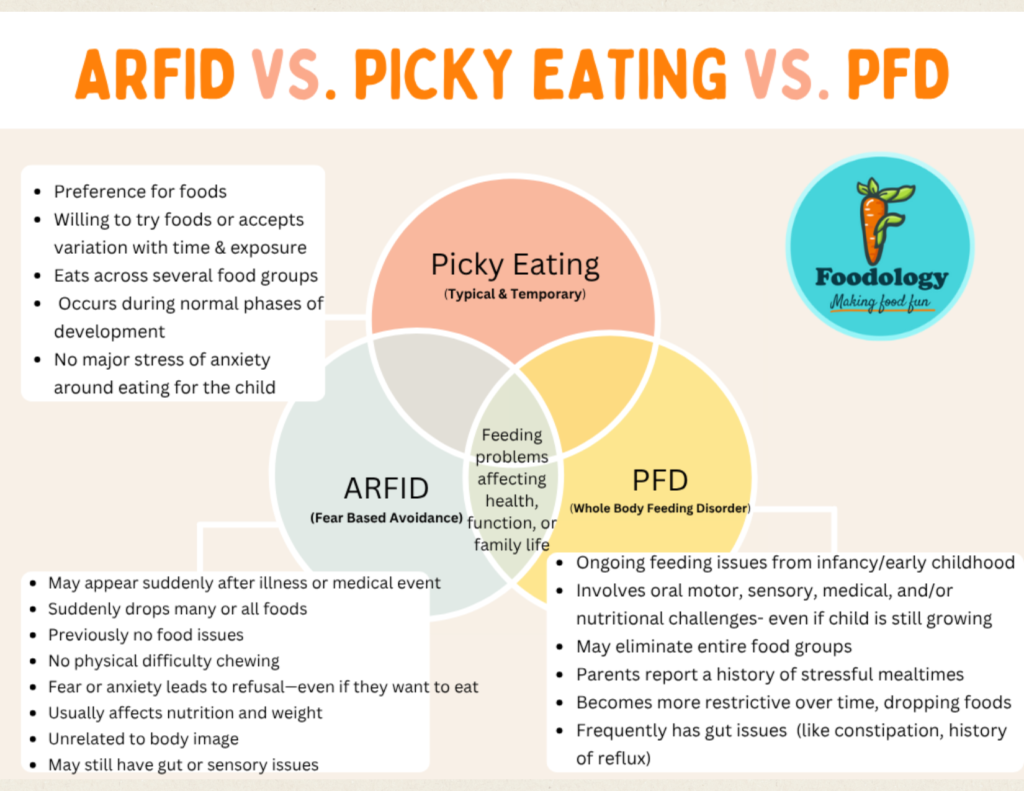
PFD, ARFID, or just picky?
Not all selective eating is the same — and not every child will grow out of it. These charts break down the key differences and what's typical at each infant feeding stage.

Trusted across specialties.
"This is exactly what I needed — clear, concise, and based on real feeding therapy experience. I keep it in my drawer for every 18-month and 2-year well check."
"I've referred multiple families to Foodology and every single one came back saying they finally felt heard. The reports are clear, actionable, and respectful of our role as providers."
Questions from referring providers
Do I need to diagnose ARFID or PFD before referring?
Not at all. We handle the evaluation and differential process. Many children don't fit neatly into a diagnosis — that's where our whole-child approach shines. You simply refer based on concern.
Do you take insurance?
We're private-pay only, so we can provide the depth of evaluation and ongoing support complex cases need. We offer a downloadable Insurance Appeal Toolkit and customized superbills to help families pursue out-of-network reimbursement. Most services are also HSA/FSA eligible.
Can you work with families outside New York?
Absolutely. We provide virtual evaluations, coaching, and courses worldwide — feeding issues don't stop at state lines, and neither do we.
What happens after I refer a family?
We begin with a thorough intake, then guide the family to the next best step — a virtual or in-person evaluation, a detailed assessment across oral-motor, sensory, nutritional, and behavioral components, and a personalized plan of care. With parent consent, you'll receive a summary of findings and brief updates, without any extra paperwork on your end.
Our clinical team is happy to help you decide if a referral makes sense.
Send parents directly to our Start Here page, or reach out to us to talk through a specific case.
Send Parents to the Start Here PageContact Us